Make Up Mirror With Lights: The Complete Buying Guide
Learn how to choose the perfect illuminated mirror for flawless makeup application, accurate color matching, and a professional vanity setup.
What You Will Learn
- Why Lighting Matters for Makeup Application
- Types of Illuminated Makeup Mirrors
- Understanding LED Lighting Quality and Color Temperature
- Magnification: Finding the Right Level for Your Needs
- Size, Shape, and Placement Considerations
- Key Features to Look For
- Power Sources and Portability
- Common Mistakes to Avoid
- Final Buying Checklist
Why Lighting Matters for Makeup Application
The quality of light you use while applying makeup directly affects the final result. Poor lighting can cause you to apply too much foundation, choose the wrong shade, or miss blending imperfections. Natural daylight is the gold standard for color accuracy, but since most people apply makeup indoors—often in the early morning or evening—an illuminated mirror becomes essential.
A make up mirror with lights replicates daylight conditions so you can see your skin tone, undertones, and product colors accurately. This means fewer surprises when you step outside or take a photo. Consistent, even lighting also helps you blend foundation seamlessly and detect fine details like stray brows or uneven eyeliner.
Pro Tip: Look for mirrors that offer adjustable color temperature settings. Being able to switch between warm, neutral, and cool light lets you preview how your makeup will look in different environments—from office fluorescent lighting to evening restaurant ambiance.
If you are building a complete vanity setup, pairing your mirror with complementary beauty tools such as a foundation brush and a makeup mirror organizer will create a functional and polished space. For those new to makeup, our getting started guide offers a solid foundation before investing in specialized equipment.
Types of Illuminated Makeup Mirrors
The market offers several distinct styles of lighted mirrors, each suited to different needs and spaces. Understanding these categories will help you narrow down your options before diving into specifications.
Tabletop Vanity Mirrors
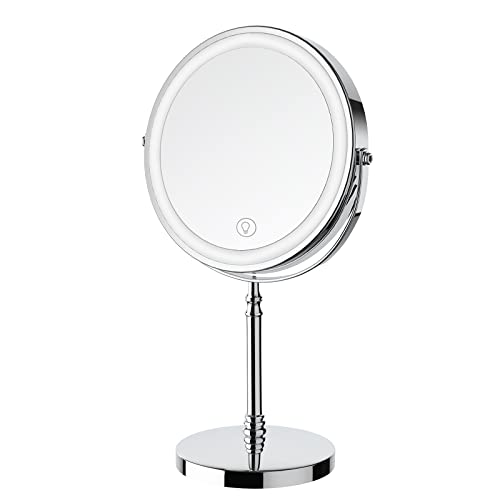
These compact mirrors sit directly on a dresser or countertop and are ideal for smaller spaces or renters who cannot install wall-mounted fixtures. Most tabletop models are lightweight and can be repositioned easily. They typically range from entry-level to mid-range in build quality, with premium versions offering metal frames and touch-sensitive controls.
Wall-Mounted Mirrors
Wall-mounted lighted mirrors provide a more permanent, integrated look for dedicated vanity areas. They free up counter space and often come in larger sizes that give you a fuller view. Installation is required, so these are best suited for homeowners or those planning to stay in their space long-term. Models in this category span mid-range to luxury tiers, with high-end options featuring dimmable LED strips and anti-fog technology.
Freestanding and Floor Mirrors
Freestanding lighted mirrors offer the height and presence of a full-length mirror while incorporating LED lighting around the frame. They are excellent for dressing rooms or bedrooms where floor space allows. Many freestanding models include adjustable brightness and a tilting mechanism for customized viewing angles.
Travel and Compact Mirrors
For frequent travelers or those who need a touch-up mirror on the go, compact lighted mirrors with rechargeable batteries are a practical choice. These are usually smaller and offer fewer features, but they deliver reliable illumination in a portable package. If you want a mirror that doubles as a decorative piece, consider a makeup vanity with mirror that combines storage and lighting in one unit.
Understanding LED Lighting Quality and Color Temperature
Not all LED lights are created equal. The two most important lighting characteristics to evaluate are color temperature and color rendering index (CRI).
Color Temperature
Color temperature is measured in Kelvin (K) and describes the warmth or coolness of light. For makeup application, a neutral daylight temperature around 5000K to 6000K is generally recommended because it closely mimics natural outdoor light. Warm light (around 2700K–3000K) flatters the skin but can distort colors, while cool light (above 6500K) can make you apply too much color to compensate for the perceived paleness.
The best LED makeup mirror with lights offers adjustable color temperature, allowing you to switch between settings for day, evening, and office lighting scenarios.
Color Rendering Index (CRI)
CRI measures how accurately a light source renders colors compared to natural sunlight, on a scale from 0 to 100. For makeup mirrors, look for a CRI of 90 or above. A higher CRI means the colors you see in the mirror will closely match how they appear in real life, which is critical for matching foundation to your neck and choosing blush and lipstick shades that complement your undertone.
Brightness and Dimming
Adjustable brightness is a must-have feature. You need brighter light for detailed work like eyeliner and brow shaping, and softer light for a natural everyday look. Look for mirrors with stepless dimming or multiple brightness levels rather than a simple on/off switch.
| Lighting Feature | Recommended Specification | Why It Matters |
|---|---|---|
| Color Temperature | Adjustable 3000K–6000K | Simulates different environments for accurate preview |
| CRI | 90+ | Ensures true-to-life color rendering |
| Brightness Control | Stepless dimming or 3+ levels | Adapts to detailed work or natural looks |
| Light Distribution | Even, shadow-free illumination | Prevents uneven makeup application |
Magnification: Finding the Right Level for Your Needs
Magnification is a defining feature of many makeup mirrors, but more is not always better. The right level depends on what you are trying to accomplish.
1x Magnification (Standard View)
This is the standard, true-to-size reflection and is essential for seeing your entire face and ensuring overall makeup balance. Every makeup mirror should offer a 1x view, either as the main surface or as a secondary panel.
2x to 3x Magnification
This range is ideal for general makeup application—applying foundation, blending concealer, and shaping brows. It provides enough detail without being disorienting.
5x to 7x Magnification
This level is best for precise tasks like tweezing, applying eyeliner, or inserting contact lenses. It is not recommended for full-face makeup application because the magnification can distort your perception of proportion.
10x and Above
These high-magnification mirrors are for very specific detail work and are rarely needed by most users. They can be useful for examining skin texture or performing intricate eye makeup, but they are not a substitute for a standard-view mirror.
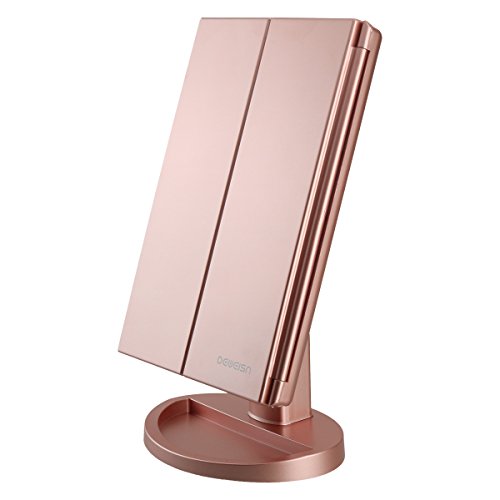
Pro Tip: The best setup is a mirror with a large 1x surface paired with a smaller detachable or reversible magnifying panel. This gives you flexibility without needing multiple separate mirrors. If you use a light up magnifying makeup mirror, check that the magnification panel is also illuminated for consistent lighting.
Size, Shape, and Placement Considerations
The size and shape of your mirror affect both functionality and the overall look of your vanity area.
Size
A mirror that is too small forces you to lean in constantly and may not show your full face at once. As a general rule, look for a mirror with a viewing surface of at least 8 inches in width for a tabletop model. Larger wall-mounted or vanity mirrors should provide a full-face view from a comfortable standing or sitting distance.
Shape
Rectangular mirrors offer maximum viewing area and a clean, modern look. Oval and round mirrors soften the space and work well in traditional or glam-style bathrooms. Square mirrors are a good compromise, providing ample surface area with a contemporary aesthetic. Consider the shape of your room and existing furniture when making your choice.
Placement and Ergonomics
Position your mirror so that the center of the glass is at roughly eye level when you are seated or standing in your usual makeup spot. If you are setting up a dedicated vanity, a makeup vanity with lights can provide a built-in solution that integrates the mirror, lighting, and storage. For smaller spaces, a lighted makeup mirror with lights that mounts to the wall or sits on a countertop can be a space-efficient alternative.
Key Features to Look For
Beyond lighting and magnification, several additional features can make a significant difference in your daily experience.
- Touch Controls: Capacitive touch sensors on the mirror surface are more durable and easier to clean than physical buttons. They allow you to adjust brightness and color temperature with a simple tap.
- Memory Function: A mirror that remembers your preferred brightness and color settings saves time and frustration each time you turn it on.
- Anti-Fog Coating: If you use your mirror in a bathroom, an anti-fog feature keeps the surface clear after hot showers. This is especially valuable in wall-mounted models.
- USB Charging Ports: Some vanity mirrors include built-in USB ports, allowing you to charge your phone or other devices while getting ready. This is a convenient feature for modern vanity setups.
- Bluetooth Speakers: A premium feature found on some higher-end models, integrated speakers let you play music or take calls while applying makeup.
- Build Quality: Look for frames made from metal or high-quality ABS plastic. Cheap materials may discolor, warp, or break over time. The base should be weighted and stable, especially for tabletop models.
If you are assembling a complete makeup kit, consider pairing your mirror with essential makeup artist tools and a well-organized makeup organizer to keep your vanity tidy and efficient. A makeup brush for liquid foundation is also a worthwhile companion for achieving a smooth, streak-free base.
Power Sources and Portability
How your mirror is powered affects where you can place it and how convenient it is to use.
Corded Electric
Plug-in models provide consistent, reliable power and are best for permanent vanity setups. They do not require charging and typically offer the brightest, most feature-rich lighting. The trade-off is that you need an outlet nearby and the cord can be a minor eyesore.
Battery Operated
Battery-powered mirrors are portable and can be placed anywhere without worrying about outlets. However, brightness may diminish as batteries drain, and you will need to keep spare batteries on hand. These are best for travel mirrors or occasional use.
Rechargeable (USB/Built-in Battery)
Rechargeable mirrors combine portability with consistent brightness. They are charged via USB and can run for several hours on a full charge. This is the most flexible option for those who want to move their mirror between rooms or take it on trips. When choosing a rechargeable model, check the battery life and charging time in the product specifications.
For a more integrated vanity experience, an LED vanity lights for mirror setup can be a great alternative if you already have a non-illuminated mirror you love. This allows you to upgrade your existing mirror without replacing it entirely.
Common Mistakes to Avoid
Even well-informed buyers can overlook important details. Here are the most common pitfalls to watch for when shopping for a lighted makeup mirror.
- Ignoring color temperature: A mirror with only warm or only cool light will distort your makeup colors. Always prioritize adjustable color temperature.
- Overestimating magnification needs: A 10x mirror sounds impressive but is impractical for everyday full-face application. Stick with a 1x primary surface and a secondary magnifying panel.
- Skimping on build quality: A flimsy base or cheap frame will lead to wobbling, scratches, and premature replacement. Invest in a well-built model from a reputable brand.
- Forgetting about placement: Measure your space before buying. A large wall-mounted mirror may not fit in a small bathroom, and a tiny tabletop mirror may feel inadequate on a spacious vanity.
- Overlooking the return policy: Lighting preferences are personal. Buy from a retailer with a generous return policy so you can exchange the mirror if the light quality does not meet your expectations.
If you are also updating your makeup collection, explore our guides on makeup products and makeup sets to complement your new mirror. For those interested in skincare before makeup, a hydrating cleanser for dry skin and a hydrating toner for dry skin can help create the ideal canvas for flawless application.
Final Buying Checklist
Before making your purchase, run through this checklist to ensure you have covered all the essentials.
- Does the mirror offer adjustable color temperature (ideally 3000K–6000K)?
- Is the CRI 90 or higher for accurate color rendering?
- Does it have stepless dimming or multiple brightness levels?
- Does it include a 1x viewing surface plus a detachable or built-in magnifying panel?
- Is the size appropriate for your space and viewing distance?
- Is the build quality solid, with a stable base and durable frame?
- Does the power source match your placement needs (corded, battery, or rechargeable)?
- Are there convenient features like touch controls, memory function, or anti-fog coating?
- Does the retailer offer a reasonable return policy?
Choosing the right make up mirror with lights is an investment in your daily routine. With the right lighting, magnification, and build quality, you will see a noticeable improvement in the precision and consistency of your makeup application. Whether you are a beginner building your first vanity or a seasoned enthusiast upgrading your setup, the information in this guide will help you make a confident, informed decision.