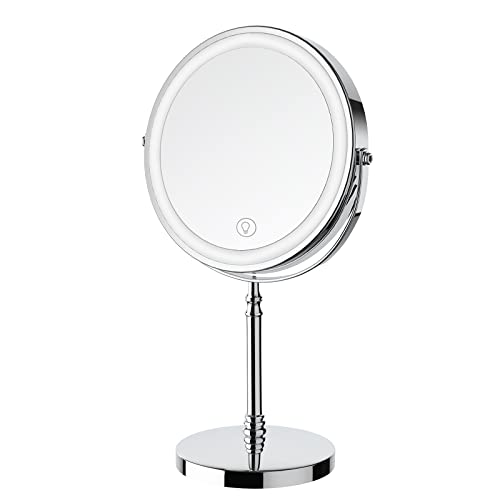
Makeup Mirror with LED Lights: The Complete Guide
Learn how LED lighting transforms makeup application, which mirror sizes and magnifications actually matter, and how to choose a lighted mirror that fits your routine, your space, and your skill level.
EXPLORE THE BUYING GUIDEWhy this guide matters: A makeup mirror with LED lights is not simply a mirror with a bulb attached. Lighting quality, color temperature, mirror clarity, and magnification all affect how your makeup looks in daylight, in an office, and under evening lights. This guide breaks down every decision so you can buy with confidence.
Why a Makeup Mirror with LED Lights Changes Your Routine
Natural daylight is the gold standard for makeup application, but most bathrooms and bedrooms do not deliver consistent, shadow-free daylight at the exact moment you need it. A makeup mirror with LED lights solves that problem by placing even, adjustable illumination directly around the reflective surface. Instead of leaning toward a window or squinting under a single overhead bulb, you get a controlled light environment every time you sit down.
The practical difference is significant. LED strips positioned around the mirror's perimeter reduce the harsh shadows that make foundation look patchy, concealer look chalky, or blush look uneven. When light comes from all sides rather than a single ceiling fixture, you see your face the way others will see it outdoors. That is why professional makeup artists, from bridal specialists to editorial teams, rely on controlled LED lighting for precision work.
LED technology also runs cooler than traditional incandescent bulbs, so you can sit close to the mirror for extended periods without heat discomfort. LEDs consume less energy and last dramatically longer, which means fewer replacements and a more consistent light output over years of use. For anyone who applies makeup daily, the upgrade from an unlit mirror to a well-designed LED mirror is one of the most noticeable improvements you can make to your routine.
Lighting Quality: Color Temperature and Brightness
The single most important specification on a lighted makeup mirror is not the number of bulbs, the frame finish, or the brand name. It is the quality of the light itself. Two measurements matter most: color temperature and brightness adjustability.
Color temperature is measured in Kelvin (K) and describes whether light appears warm (yellow-orange), neutral (white), or cool (blue-white). A mirror that only offers one fixed temperature limits you to a single lighting scenario. A mirror with adjustable color temperature lets you preview your makeup under the warm light of a restaurant, the neutral light of an office, and the cool light of daylight. The most useful range for makeup application sits between roughly 3000K and 6000K.
Brightness adjustability matters just as much. A mirror that is bright enough for detailed eyeliner work may be too intense for a quick daytime touch-up. Dimming controls, whether stepless or stepped, let you match the light level to the task. If you often apply makeup in the evening, a mirror with a low dim setting prevents the harsh, washed-out look that overly bright light can create.
| Color Temperature | Appearance | Best Use Case |
|---|---|---|
| Warm (around 3000K) | Soft yellow-orange glow | Evening looks, warm indoor venues, cozy bathroom lighting |
| Neutral (around 4000K) | Clean white light | Everyday office and indoor makeup application |
| Daylight (around 5000K–6000K) | Crisp, slightly cool white | Outdoor events, photoshoots, color-matching foundation |
Mirror Size and Shape: Matching the Mirror to Your Space
Size is a practical decision as much as an aesthetic one. A compact tabletop mirror works well in a small bedroom or a shared bathroom, while a large vanity mirror with LED lights becomes a permanent fixture that anchors an entire dressing area. Before choosing, measure the surface where the mirror will live and consider how much arm movement you need during application.
Compact tabletop mirrors typically range from small round designs to rectangular models with a folding stand. They are ideal for travel, dorm rooms, and bathrooms with limited counter space. Many compact mirrors include a rechargeable battery and a USB port, making them genuinely portable.
Freestanding vanity mirrors are larger, often rectangular or oval, and stand on a weighted base. They offer a wider viewing area and are the most common choice for home dressing tables. If you want a mirror that doubles as a statement piece, a makeup vanity with mirror setup combines storage and lighting in one unit.
Wall-mounted and Hollywood-style mirrors are the largest option and are typically installed above a vanity counter. They free up surface space and provide the most immersive, shadow-free lighting. Hollywood mirrors with exposed bulb rings are a popular aesthetic choice, though modern LED strip designs often deliver more even light with less glare.
Shape matters for framing your face. Round and oval mirrors soften the composition and work well in compact spaces. Rectangular mirrors provide more usable reflective area and suit detailed work. If you plan to film tutorials or take photos, a rectangular mirror with a wide field of view is generally more practical. For a broader overview of mirror styles beyond the LED category, see our general makeup mirror guide.
Magnification: How Much Is Actually Useful
Magnification is one of the most misunderstood features of a lighted makeup mirror. More is not always better. The right magnification depends on what you are doing and how much detail you genuinely need to see.
- 1x (standard): The primary mirror surface. Use it for foundation, blush, bronzer, and overall look assessment. Every mirror needs a strong 1x surface.
- 3x–5x: Helpful for brows, lip liner, and general detail work. This range is comfortable for most users and does not distort the face too aggressively.
- 7x–10x: Reserved for precise tasks such as eyeliner wings, individual lash placement, and tweezer work. Useful for experienced users but can feel intense for beginners.
- Above 10x: Rarely necessary for home use. High magnification exaggerates pores and texture, which can make you over-correct your makeup.
A mirror with a detachable or inset magnifying section gives you flexibility without forcing you to commit to a single magnification level. If you only have space for one mirror, choose a model that pairs a large 1x surface with a smaller 5x inset. For a closer look at magnifying options, our guide to the light-up magnifying makeup mirror covers the trade-offs in more detail.
Smart Features Worth Paying For
Touch Dimming
Touch-sensitive controls let you adjust brightness without fumbling for a dial. Look for stepless dimming if you want fine control over light intensity.
Adjustable Color Temperature
Switching between warm, neutral, and daylight tones helps you preview makeup in different environments before you leave the house.
Rechargeable Battery
Cordless mirrors with USB-C charging are ideal for travel and for vanities without a nearby outlet. Battery life varies, so check runtime.
Memory Function
A mirror that remembers your last brightness and color setting saves time every morning and keeps your routine consistent.
Rotating or Tilting Stand
Adjustable angles help you find a comfortable viewing position, especially if you sit at different heights or share the mirror.
Built-In Outlet or USB Port
Some vanity mirrors include a power outlet or USB port for charging tools, reducing cable clutter on your dressing table.
Entry-Level, Mid-Range, and Premium Mirrors
LED makeup mirrors fall into broad quality tiers that reflect build materials, lighting precision, and feature depth. Understanding these tiers helps you match a mirror to your needs without over- or under-buying.
Entry-level mirrors typically offer a single color temperature, basic on/off control, and a compact frame. They are a solid starting point for beginners or for a secondary mirror in a guest room. The trade-off is less lighting flexibility and often a smaller viewing surface.
Mid-range mirrors are the sweet spot for most daily users. They usually include adjustable color temperature, touch dimming, a rechargeable battery or a reliable corded connection, and a sturdier stand. This tier is where you start to see consistent lighting across the entire mirror surface rather than a single bright hotspot.
Premium mirrors focus on even light distribution, high color rendering, wide viewing areas, and premium materials such as metal frames and glass rather than acrylic. They may include memory settings, integrated outlets, or Hollywood-style bulb arrays. If you apply makeup professionally or film content regularly, the premium tier is where the investment pays off. For a deeper comparison of illuminated styles, see our guide to the lighted makeup mirror with lights.
How to Choose: A Step-by-Step Buying Checklist
- Measure your space. Confirm the footprint of the mirror and the clearance needed for your arms and tools. A mirror that is too large for the surface becomes a daily annoyance.
- Decide on primary use. Daily quick makeup, detailed editorial work, and travel each call for different priorities. Match features to the job.
- Check color temperature options. At minimum, look for a daylight setting. Adjustable temperature is strongly preferred if you apply makeup for evening events.
- Confirm dimming control. Touch dimming or a stepless dial gives you control over intensity. Fixed brightness is a common regret among buyers.
- Choose magnification wisely. Pair a large 1x surface with a 5x inset rather than relying on a single high-magnification mirror.
- Evaluate build quality. Metal frames and real glass outlast plastic and acrylic. Check the stability of the base, especially on larger mirrors.
- Plan for power. Decide between corded and rechargeable based on outlet access and whether you travel with the mirror.
- Consider the light spread. Perimeter LED strips generally distribute light more evenly than a single bulb at the top. For vanity setups, pair the mirror with dedicated LED vanity lights for mirror installation if you need broader room lighting.
Placement, Setup, and Care
Where you place your mirror affects how useful its lighting actually is. Position the mirror so that the light surrounds your face rather than hitting it from one side. Avoid placing the mirror directly opposite a window if you can, since backlighting creates silhouettes and hides detail. A mirror placed at a slight angle to a window often gives the best of both natural and LED light.
Keep the mirror surface clean with a microfiber cloth and a mirror-safe cleaner. Avoid spraying liquid directly onto the glass, especially near LED strips or control panels. For rechargeable mirrors, follow the manufacturer's charging guidance and avoid leaving the battery fully depleted for long periods.
If you are building a dedicated dressing area, pair your mirror with organized storage. A makeup organizer keeps brushes and products within reach, and a travel case protects a compact mirror when you are on the move. A clutter-free vanity makes the lighting more effective because you are not casting shadows with stacked products.
Common Mistakes to Avoid
- Buying purely on brightness. A mirror that is too bright washes out detail and encourages over-application. Adjustability matters more than raw output.
- Ignoring color rendering. A mirror that makes colors look slightly off will make your foundation matching unreliable. Look for high color rendering where specified.
- Over-magnifying. A 10x mirror is a tool, not a daily driver. Most users are better served by a strong 1x surface with a smaller magnifying inset.
- Forgetting the power source. A beautiful mirror without a nearby outlet becomes a paperweight. Check cable length and outlet placement before buying.
- Choosing style over stability. A top-heavy mirror on a narrow base tips easily. Prioritize a stable base, especially in households with children or pets.
Frequently Asked Questions
Are LED lights in makeup mirrors better than standard bulbs?
LED lights run cooler, use less energy, and last far longer than traditional bulbs. They also allow for adjustable color temperature, so you can switch between warm, neutral, and daylight tones to match different environments.
What color temperature should I look for in a lighted makeup mirror?
A neutral daylight setting around 5000K to 6000K is the most versatile for makeup application. Mirrors that also offer a warmer 3000K setting and a cool 4000K setting give you flexibility for day and evening looks.
How much magnification do I need on a makeup mirror?
A standard 1x mirror is ideal for overall application, while a 5x to 10x magnifying section helps with brows, eyeliner, and detailed work. Avoid going above 10x unless you have a specific need, since higher magnification can be disorienting and shows every pore.
Can I use a lighted makeup mirror for professional work?
Yes. Many makeup artists use larger LED mirrors with adjustable color temperature and dimming controls to ensure consistent lighting across clients and locations. Look for a mirror with a wide viewing area and stable base.
Do lighted makeup mirrors need to be plugged in?
Most larger mirrors require a power outlet, while compact travel mirrors often run on USB or batteries. If portability matters, choose a rechargeable LED mirror with a built-in battery.
Bottom line: The best makeup mirror with LED lights is the one that matches your space, your routine, and your level of detail work. Prioritize adjustable color temperature, dimming control, and a stable build over flashy extras. Once you have those fundamentals, the mirror becomes a reliable tool rather than a novelty, and your makeup application becomes faster, more consistent, and more accurate.